
Application led chemical additives for drilling, cementing,
stimulation, completion and production
engineered to
solve field problems from fluid control to H₂S mitigation.
FROM LAB BENCH TO BOREHOLE CHEMISTRY.
EXPLORAX engineers fit-for-purpose chemical solutions for upstream oil & gas operations by integrating specialty polymers, bio-breakers, H₂S scavengers, surfactants, defoamers, colloidal and micro-silica systems, and high-strength engineered microspheres. Our development approach connects bench formulation, compatibility screening and performance testing with the realities of drilling, cementing, stimulation and production service. Each chemistry is considered against the actual fluid environment—temperature, salinity, pH, shear, pressure, contamination risk, density window and treatment objective—so laboratory performance can be translated into more dependable field execution. From an initial 1–5 litre evaluation batch to pilot blending and commercial supply, EXPLORAX is structured to help operators and service companies move faster from technical problem definition to a practical, field-ready chemical solution.
Precision Chemistry Matching
Formulations are screened against real-world bottom-hole temperature ranges, mono- and multi-valent brine salinities, pH windows, shear regimes, fluid contamination, additive compatibility and tight density targets. The objective is to identify the chemistry and dosage window that best fits the actual job environment rather than relying on generic product selection.
Scalable Commercial Agility
Development can progress from laboratory screening and pilot custom blends to field-ready drums, IBCs or bulk supply. Scale-up is supported by batch QA, viscosity and density checks, fluid compatibility review, application guidance and technical documentation so the selected chemistry remains consistent as volumes increase.
SOLUTIONS ACROSS THE WELL.
A focused portfolio for well construction, stimulation and production, organized around the chemistry of the actual system rather than a one-product-fits-all approach.
H₂S Scavengers
MEA-triazine based liquid scavengers for hydrogen sulphide reduction in hydrocarbon and process applications, available in multiple concentration options.
Cement & Spacer
Additives
Silica, spacer polymers, density-control materials and foam-control additives for slurry and spacer formulation.
Enzyme Gel Breakers
Enzyme systems for guar, xanthan, starch and selected polysaccharide residues.
FOAMSTAB Defoamers
EO/PO, silicone and silicone-free defoamer chemistries for cementing and oilfield formulations.
Drag Reducing Agents ↗
Polymeric drag reduction technologies for pipeline and fluid-transfer applications.
Wetting Agents
Specialty surface-active chemistries for high-efficiency wetting and surface-tension modification.
Hollow Glass
Microspheres/Bubbles
GEOSPHERES HGS Series · high-strength hollow glass bubbles for lower-density oil and gas fluids, cementing systems and lightweight applications.
Oilfield Latex
Latex polymer chemistry for gas migration control in oilwell cement and selected drilling-fluid applications. Formulation compatibility and performance are screened against job conditions.
Potassium Formate
75% Brine
High-density potassium formate brine concentrate for drilling and fluid-conditioning systems where density and fluid compatibility are critical.
Demulsifiers
Chemistry for separating water from produced crude oil emulsions and supporting oil treatment, dehydration and water cleanup.
CHEMISTRY BY WELL STAGE.
Different operations place very different demands on chemistry. EXPLORAX organizes product selection around the job stage and the dominant performance requirement.
Drilling & Fluid Conditioning
Wetting, foam management and selected fluid-performance chemistry for difficult operating environments.
Cementing & Spacer Placement
Density-control fillers, micro-silica, colloidal silica, spacer polymers and defoamers supporting slurry design and displacement.
Stimulation & Cleanup
Enzyme technologies targeted to specific polysaccharide structures to reduce residual viscosity after treatment.
Production & H₂S Control
Triazine scavenging chemistry and supporting additives for treating sour hydrocarbon streams and process systems.
Transport & Flow Assurance
Drag-reducing polymers and supporting chemistry for pipeline throughput and transfer operations.
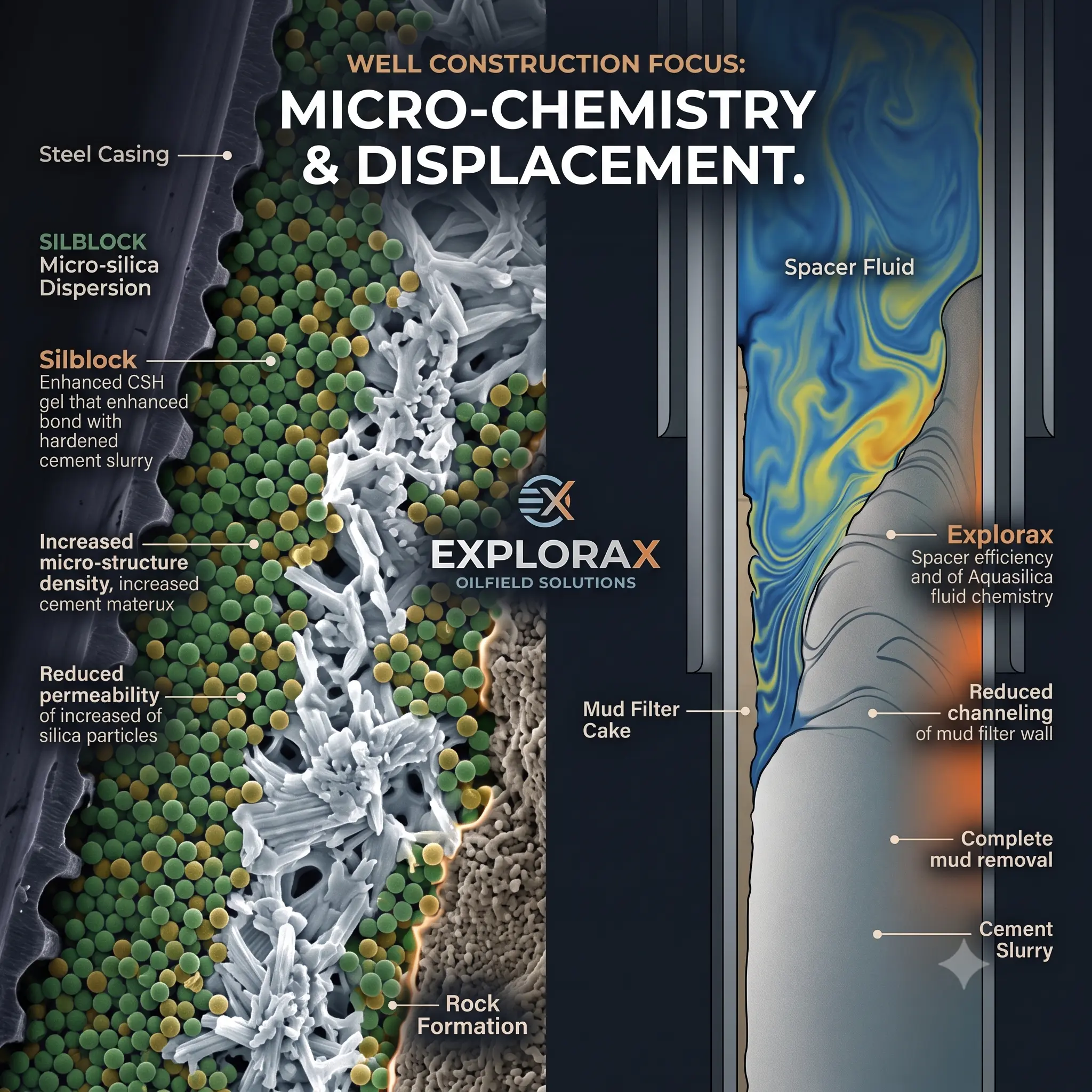
CEMENTING &
SPACER
CHEMISTRY.
For cement systems, compatibility is as important as the individual component. EXPLORAX can support the selection of spacer polymers, latex gas-migration additives, silica systems, defoamers and lightweight materials around slurry density, rheology, temperature and pressure requirements.
PRODUCT
REFERENCE.
Representative EXPLORAX technologies. Final grade selection and dosage should be validated against the specific fluid system and operating conditions.
TEST. ADAPT.
OPTIMIZE.
Oilfield formulations are sensitive to temperature, salinity, pressure, polymer type, cement chemistry and dosage sequence. Our application approach starts with the actual system and performance target.
Compatibility Screening
Check interaction with brines, polymers, cement slurries and job additives.
Dosage Optimization
Establish a practical starting window before field evaluation.
Performance Benchmarking
Compare against an incumbent chemistry or defined target.
Scale-Up Support
Move from lab sample to pilot and commercial supply.

OILFIELD
CHEMICAL
FAQ.
General guidance only. Final product selection should be based on fluid chemistry, temperature, pressure and the required performance target.
EXPLORAX presents additive families for drilling, cementing, stimulation and production, including spacer polymers, silica systems, hollow glass microspheres, enzyme gel breakers, defoamers, wetting agents, drag reducing agents and H₂S scavengers.
Cementing programs may use polysaccharide spacer additives such as SP-182P, silica technologies, lightweight hollow glass microspheres, latex for gas migration control and defoamers. Selection depends on the actual cement slurry and well conditions.
A polysaccharide-based spacer additive helps develop the fluid body and suspension needed in an engineered spacer. EXPLORAX SP-182P is a spacer polymer option to screen for rheology, compatibility and displacement performance.
Hollow glass microspheres can reduce formulation density. Choose a GEOSPHERES HGS grade by target density, expected pressure and crush-strength needs, then validate the complete cement slurry.
SILBLOCK micro-silica and Aquasilica colloidal silica are different particle systems. Their formulation roles, solids content and compatibility should be evaluated separately in the intended cement or spacer fluid.
Enzyme breakers target specific polysaccharide structures. BIOBREAKER grades address guar, xanthan or starch-based residues; the right grade is selected using the fluid polymer, temperature, pH and brine composition.
FOAMSTAB defoamers can be screened for foam control in drilling fluids, cement slurries, stimulation fluids and production systems. Dosage and chemistry depend on the fluid and required foam knockdown.
Drag reducing agents are evaluated to lower friction losses during fluid pumping and transport. GEODRAG chemistry choices should be matched to the fluid phase, flow conditions and injection point.
SURFITON wetting-agent selection begins with the required oil-wetting or water-wetting effect, followed by compatibility checks with the base fluid, solids and other additives.
Share the application, fluid composition, temperature, pressure and performance target. Laboratory screening with the actual fluid system helps determine the suitable chemistry and dosage.
HAVE A WELL
CHEMISTRY
PROBLEM?
Share the application, fluid composition, temperature, pressure and current performance target. We can shortlist the most relevant EXPLORAX chemistry for evaluation.
START A TECHNICAL DISCUSSION ↗